martedì 17 febbraio 2015

Un fotografo di provincia mi parla del suo lavoro e della zincografia

Franco Franzini con una sua fotografia che ritrae una schermitrice

Ho conosciuto un fotografo di provincia che ha lavorato per un lunghissimo periodo della sua vita per un quotidiano locale e anche per riviste mensili ed altri ambiti che richiedevano la sua esperienza e l'utilizzo della fotografia, come veniva intesa nel periodo in cui il fotografo era riconosciuto come un abile creativo che agiva sia sul campo che in studio, adoperando il proprio gusto e conoscenze tecniche non comuni.
Ascoltando direttamente da Franco Franzini in cosa consisteva il suo lavoro ci si rende conto dei grandi cambiamenti della nostra società, delle esigenze del committente e della velocità con la quale si riuscivano a fare le cose in passato, grazie al contributo di varie figure professionali che ora sono completamente scomparse per lasciare spazio a poche persone che gestiscono la stampa a rotocalco di quotidiani e riviste.
Il processo produttivo per trasformare le fotografie in immagini da stampare su carta per mezzo di matrici a rilievo è molto cambiato negli ultimi 30 anni, da una tecnica fotomeccanica e chimica di tipo tipografico si è passati all'uso del computer per le tecniche digitali che poi vedono l'utilizzo di lastre di gomma, la flexografia.
Il sito stesso dove avveniva gran parte del lavoro fotografico, di preparazione della matrice e di stampa è oggi in condizioni di semiabbandono, è qui che ho incontrato Franco per capire come avvenissero le cose un tempo e subito m'è sembrato d'entrare in un mondo dimenticato che non interessa più nessuno, dove il nostro fotografo continua a muoversi come un unico essere sopravvissuto ad una epidemia che ha spazzato via tutti.
In un ambiente disordinato ed impolverato trovano ancora ricovero le attrezzature che servivano ad illuminare ed a riprendere i soggetti, qua e la montagne di negativi infilati in grandi sacchi, ma anche conservati con più cura.

Vecchie fotografie

In una stanza si trova un vecchio ingranditore Durst Laborator 3S con il piano basculante che serviva a stampare fino al formato di cm. 13X18 (5X7), ma anche a riprodurre le immagini di cui si volevano preparare le matrici di zinco per la stampa tipografica.

Il Laborator 3S

Moltissime fotografie qua e là raccontano le storie di una vita trascorsa a documentare gli avvenimenti che allietavano, divertivano o preoccupavano i concittadini di Franco.

La piena del grande fiume

Le tipiche barche del Po

In un salone più grande, su alcuni tubi d'alluminio, trova posto un fondale di carta che fa da sfondo ai personaggi ed agli oggetti ripresi in studio, è ancora presente un sistema d'illuminazione a luce diffusa, il bank aereo che negli anni 1970 era stata una grande innovazione, ma che ora utilizzano in pochi.

Una vecchia Fatif 13X18 è la fotocamera che Franco usa ancora oggi

In giro ci sono dei mobili, libri, grandi lastre di zinco, caratteri di piombo, stativi, vecchi corpi illuminanti ed altre cose. Non si riesce però ad accendere la luce perché i recenti temporali hanno probabilmente causato qualche corto circuito, pertanto restiamo per un po' in penombra; poi Franco traffica con dei cavi e riesce a ripristinare l'energia.

La camera oscura ed il Durst 609

In un'ultima stanza, un po' più piccola c'è un'altra camera oscura con un altro ingranditore Durst più piccolo: è un 609 che risale, come l'altro, intorno alla fine degli anni 1960, ogni tanto viene ancora usato per stampare i formati più piccoli, mentre il grande formato viene stampato a contatto.

Scarto negativo

Scarto positivo

Vengo a sapere che negli anni passati non c'era nemmeno bisogno della carta autopositiva, o delle Polaroid, se si voleva realizzare subito una stampa, ad una fiera, per esempio, o ad un altro evento pubblico in cui c'era la necessità di consegnare subito una stampa all'interessato, si fotografava il soggetto inserendo carta fotografica nello chassis, poi lo si sviluppava in bacinella e dopo averlo fissato, lavato e velocemente asciugato, lo si rifotografata con un'altro foglio di carta in modo da ottenere un positivo.
Riesco a farmi dare un foglio negativo da pubblicare sul blog, si tratta di uno scarto che aveva contaminato con gli acidi mentre operava questa dimostrazione lo scorso settembre a Castel San Giovanni, in mezzo a una gran folla che forse lo disturbava nel procedere con i suoi sviluppi.

Morin

Per la città, il fiume è fondamentale, Franco inizia a raccontarmi di tutta una serie d'episodi e di personaggi che non esistono più, ma che lui ha conosciuto e fotografato.
Un'altra sua passione era lo sport ed il pugilato in particolare.

Un momento di un combattimento di boxe fissato dalla fotocamera di F. F.

Mi fa vedere la fotografia che gli avevano fatto i suoi colleghi quando era andato in pensione e tante altre immagini che fanno parte della sua storia.
Resto un po' perplesso vedendo sacchi di plastica del tipo usati per buttare la spazzatura pieni di negativi e gli chiedo se me li può dare, ma lui dice che ne posso scegliere un solo spezzone. Nonostante sia già tutto materiale inservibile ed in pessime condizioni di conservazione, non se ne vuole privare, non si sa nemmeno se al quotidiano qualcuno si ricordi ancora che esista questo “archivio”.

Franco e alcuni vecchi negativi che ha pescato da un sacco della spazzatura

Ritengo che si tratti di scatti che non sono mai stati utilizzati e che probabilmente il giornale conservi solo quello che ha pubblicato, ma è una cosa che penso tra me e me, per giustificare a me stesso quello che vedo.
Da una parte resto perplesso, davanti a me c'è questo palazzo caduto nell'oblio ed uno spiazzo antistante che forse stanno solo attendendo d'essere venduti, ma dall'altra resto affascinato nel vedere quest'uomo che continua a mettere delle specie d'impalcature per puntellare un mondo che ormai gli è già crollato addosso, senza che lui potesse impedirlo.
Forse, in realtà, stiamo tutti vivendo un po' così di questi tempi nei quali non c'è dato di sapere quanto può durare l'ultima tecnologia, o perché non esistono più certezze su questo mondo e nemmeno di che cosa vivremo domani.
Finalmente, guardo Franco, lo riporto bruscamente nel tempo presente decidendomi a chiedergli quello che più mi interessa, per farmelo spiegare un po' più nel dettaglio.
Forse, lui è un po' deluso che io mi voglia far raccontare proprio uno dei passaggi del suo lavoro che probabilmente per lui non erano tra i più esaltanti.
Alla sua epoca, comprendo che si doveva lavorare tantissimo, di giorno si facevano i servizi fotografici, poi si sviluppavano le pellicole ed infine, di notte bisognava lavorare in tipografia per preparare le matrici delle lastre di zinco che poi sarebbero servite ad illustrare le pagine del giornale.
Per me si tratta di una lavorazione che non conoscevo e non ho mai visto, così cerco d'ascoltare con attenzione per capire se possa ancora essere di qualche utilità conoscere questa tecnica conosciuta come zincografia.

Un momento della vita lavorativa di Franco

<Per prima cosa bisogna riprodurre la fotografia che si è scelto utilizzando l'ingranditore, mettendo un reticolo tra la fotografia e la pellicola lith. L'obiettivo dell'ingranditore (riproduttore) riprende la fotografia, si mette il retino nel porta negativo e sopra la pellicola da esporre; si illumina il soggetto da riprodurre e si impressiona la pellicola lith, dopo si sviluppa la pellicola esposta nello sviluppo lith, si otterrà così un'immagine con un reticolo in mezzo di 25/40 linee/mm.
Una volta asciugata questa pellicola negativa, la si pone a contatto con una lastra di metallo sensibilizzata con una colla speciale, noi per esempio, usavamo la Freuendorfer una colla sensibile tedesca. Si distribuiva questa colla sulla lastra in modo uniforme per mezzo di una centrifuga e si faceva asciugare il tutto. Poi veniva trasferita la negativa sulla lastra di zinco proiettando l'immagine da stampare per mezzo di luci ad arco di carboni che emettevano una luce UV. Si impressiona lo smalto con la luce UV, dopo si prende questa lastra impressionata, si spoglia con l'acqua per cuocerla ad una temperatura di 300° circa, finché diventa marrone lo smalto, così che poi è pronta per l'incisione all'acido nitrico che è diluito 1:4 – 1:5.
Buttata sulla lastra crea degli alti e dei bassi, dove c'è lo smalto l'acido non incide, mentre l'acido inciderà dove è andato via lo smalto scavando un solco di una profondità che varia a secondo di quanto la si lascia in immersione nell'acido.
Poi la lastra viene tagliata e stampata.
Per stampare l'immagine la si monta su una pagina, la si inchiostra e per mezzo di un torchio si preme la carta sul cliché ed è così che esce la stampa sulla carta.
Io facevo il cliché per metterlo nella pagina del giornale.>

Pugilato Fotografia di F. F.

Questo è quello che mi ha detto Franco Franzini, un fotografo come ce ne sono stati tanti, un po' dappertutto in Italia e come tutti loro, un po' speciale.

Franco è nato il 15.4.1938, nel 1955 a 17 anni inizia a lavorare per la Libertà, giornale col quale collabora per circa 60 anni, poiché ancora oggi lui è considerato come una persona in grado di rendersi utile. Tony Graffio

English Text


Franco Franzini Photographer and Zincographer

I met a photographer from the province who worked for a very long period of his life for a local newspaper and also for monthly magazines and other areas that needed his experience and the use of photography. Time ago the photographer was recognized as a skilled creative acting in the field or in the studio, using his own taste and not common technical knowledge.
Listening directly from Franco Franzini about his work we realize the great changes of our society, the needs of the client and the speed with which you could do things in the past, thanks to the contribution of various professionals who now have completely disappeared to make room to a few people who run the rotogravure printing of newspapers and magazines.
The production process to transform photographs into images to be printed on paper by means of matrices relief has changed a lot over the last 30 years. From a technical-mechanical and chemical type typographic we moved to the use of computers to digital techniques which then see the use of rubber sheets, flexography.
The site where it was much of the photographic work of preparation of the matrix and the print is today in conditions of semi-abandonment, that is where I met Franco.
To have been here helped me to understand how things worked in a newspaper until 30 years ago. Now I seemed to enter into a forgotten world where our photographer continues to move as a single surviving to an epidemic that has swept away all.
In a messy and dusty shelter, I still find the equipment that served to illuminate and to record the subject. Here and there, I can see also mountains of negative stuffed into large bags, but also preserved more carefully.

In one room there is an old enlarger Durst Laborator 3S with a tilting plan that was used to print up to the format cm. 13X18 (5X7), but also to reproduce the images that you want to prepare arrays of zinc for letterpress printing.

Many photographs here and there tell the stories of a past life to document the events that entertained, amused or worried about the fellow citizens of Franco.

In a larger room, on some aluminum tubes, is placed a backdrop of paper that is the background to the characters and objects taken in the studio, there is still a lighting system with diffused light, the bank plane in years 1970 was a great innovation, but now a few photographers use such light system.

Around there are furniture, books, large sheets of zinc, lead characters, tripods, old light fixtures and other things. But you can not turn on the light because the recent storms have probably caused some short circuit, so we stay for a while in the twilight; then Franco toches some cables and can fix the energy black-out.

The last room is a bit smaller, here there is another darkroom with another smaller Durst enlarger, it is a 609 that goes back, like the other, around the end of 1960. Franco still uses occasionally it to print smaller sizes format, while the large format are printed in contact.

I hear that in the past photographers did not even have self positive paper, or Polaroid, if you wanted to create print immediately, at a trade show, for example, or at other public event where there was the need to immediately deliver a print to the person, the subject were photographed by inserting photo paper in the chassis, then it was developed in the basin and after fixed, washed and dried quickly, you have to take another picture with another sheet of paper to obtain a positive .
Franco gave me a negative sheet to publish on the blog, it's a discard that had contaminated with acids while operating this demonstration last September in Castel San Giovanni.

For the city, the river is crucial, Franco began to tell of a series of episodes and characters that do not exist anymore, but he has seen and photographed.
Another passion was sport and boxing in particular.

He shows me the photograph which had made his colleagues when he was retired and many other images that are part of its history.
I'm a bit surprised of seeing plastic bags of the type used to empty the garbage full of negative and ask him if I can take them, but he says that I can choose a single chunk. Although it looks all useless material and in poor storage conditions, he did not want to lose his photographs, you do not even know if in the newspaper someone still remembers that there is this "archive".

I think this is of shots that have never been used and that the newspaper probably keep only what he published, but it is something that I think to myself, to justify to myself what I see.
On one side I was perplexed to see this building fell into oblivion and a forecourt that maybe is just waiting to be sold, but on the other I am fascinated to see this man who continues to try to save a world that it has already collapsed on him, without he could do anything to stop the time.
Perhaps, in reality, we are all living a bit so i these days where there is no data to know how much can last the latest technology, or because there are no more certainties in this world, nor of what we will live tomorrow.
At his age, I understand that you had to work a lot, you did the day of photo shoots, then developed films and finally, at night you had to work in typography to prepare arrays of zinc plates that later would serve to illustrate the pages of newspaper.
For me it is a process that I did not know and I have never seen, so I try to listen carefully to see if it can still be useful to know the technique known as zincography.

This is what Franco remembers of that technique.

<First you need to reproduce the picture you chose using the enlarger, putting a mezzotint screen between photography and film lith. The goal of the enlarger (player) takes the photograph, you put the screen in the door and above the negative film to expose; lights to be reproduced and exposing the film lith, after developing the exposed film in development lith, so you will get an image with grid in the middle of 25/40 lines / mm.
When this negative film is dried, the negative is contacted with a metal plate coated with a special glue. We used the Freuendorfer, a sensitive German glue. This glue is distributed on the plate in a uniform manner by means of a centrifuge and later was drying.
Then it was transferred to the negative on zinc plate projecting the image to be printed by means of arc lights of carbon emitting UV light. It impresses the enamel with UV light, after you take this plate impressed. It is stripped with water.
The plate had to cook to a temperature of approximately 300 °, until it becomes brown enamel, so that it is then ready for etching by nitric acid which, usually diluted 1: 4 - 1: 5.
Thrown on the plate, this liquid creates ups and downs, where there is the acid does not affect the enamel, while the acid will affect where you went away the enamel digging a furrow to a depth that varies according to how much is left in immersion in acid.
Then the plate is cut and printed.
To print the image is mounted on the one page, it is inked by means of a press and press the paper onto the cliché and it is so coming out printing on the paper.
I did the cliché to put it on the page of the newspaper.>


Franco was born on April 15th 1938, in 1955 at age 17 he began working for La Libertà (Freedom), newspaper with he collaborates for about 60 years, since he is still considered as a person in a position to be helpful. Tony Graffio


mercoledì 17 dicembre 2014

Originali, falsi e copie, alcune Leica a vite a confronto

Dopo più di 70 anni dalla loro fabbricazione, a volte si fa fatica a riconoscere una Leica da un'altra, figuriamoci cosa voglia dire saper riconoscere una Leica da un falso. 
Una volta però che si hanno a disposizione più pezzi per un confronto diretto può essere divertente iniziare una specie di gioco per trovare le differenze visivamente più evidenti.

Iniziamo il gioco del vero o falso?
The true or fake game is going to start...

Poter prendere in mano una macchina fotografica marchiata Leica rende immediatamente l'idea di cosa significhi la meccanica di precisione; se poi si prova a far avanzare la pellicola, far scattare l'otturatore, o più banalmente ad aprire il fondello per caricare un rullino di pellicola tutto risulta più chiaro.
Leica rivoluzionò la storia della fotografia e la vita di molti fotografi consentendo di avere a disposizione una fotocamera maneggevole, rapida nell'utilizzo, robusta e con ben 36 scatti nel formato di mm 24X36 in un apposito caricatore a tenuta di luce.
Leica non fu la prima fotocamera ad utilizzare la pellicola cinematografica (risale al 1908 il primo progetto disegnato da 3 soci catalani per la Lleo Camera; altri pionieri disegnarono e realizzarono dei prototipi, mentre la prima fotocamera 35mm prodotta e commercializzata fu l'americana Tourist Multiple del 1913 che esponeva fotogrammi di mm 18X24, come il quadruccio da ripresa cinematografico), ma fu la prima ad ottenere un grande successo commerciale, grazie alla sua ottima progettazione e qualità, oltre che ad una forma accattivante, moderna e gradevole.
L'altro punto di forza della Leica furono le ottiche di qualità, progettate da Max Berek. Fu proprio lui a disegnare dapprima l'Elmax 50mm f 3,5, (anni di produzione 1921-1925) migliorandolo poi in quello che sarà l'Elmar 50mm f 3,5 rientrante, un obiettivo molto particolare, a 4 lenti, con montatura sia a vite M39X1 che a baionetta M, prodotto fino al 1961. Nel 1957, a questo obiettivo venne affiancato e poi sostituito, dal favoloso, ancora oggi, Elmar  50mm f 2,8.
In totale, in 35 anni furono prodotti 380'000 Elmar 50mm f 3,5.
La logica conseguenza di questo successo tecnico e commerciale s'iniziò ad avvertire fin dagli anni 1930 quando in molti copiarono spudoratamente le piccole fotocamere tedesche, al punto che divenne piuttosto agevole cancellare i marchi dei prodotti russi per incidere poi il logo Leica ed un numero di matricola plausibile.
Furono soprattutto i polacchi ad occuparsi di questa attività partendo dalle fotocamere costruite in Ukraina fin dal 1934, le Fed.


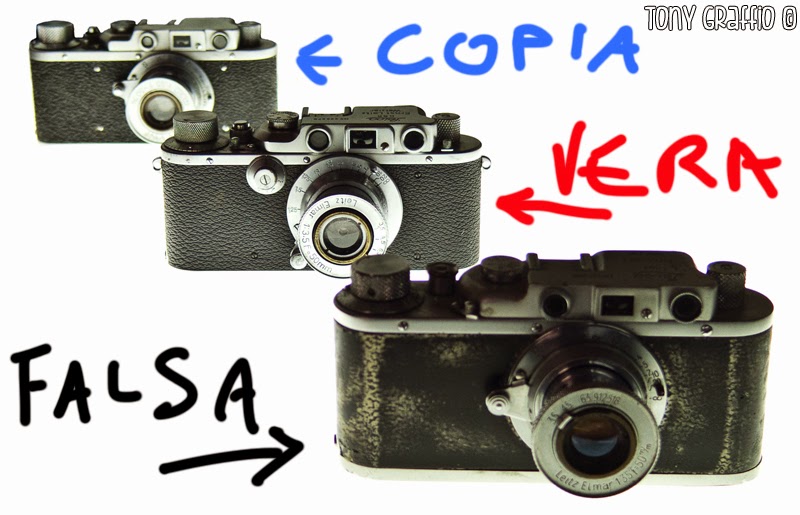
Sono partito nel mio confronto prendendo in considerazione 3 diverse fotocamere: una Fed Type 1b del 1936 circa, copia trasformata in una falsa Leica IID.
Le Fed sono difficilmente identificabili con precisione poiché fino al 1955 erano prive del numero di matricola.

Fed Type Ib (1936) Falsa Leica IID e falso Leitz Elmar 50mm f 3,5
Fed Type Ib 1936, fake of a Leica IID, also the Elmar is fake (look at the crazy m/m written)

Poi ho preso una Leica IIIB autentica che dovrebbe essere stata prodotta intorno al 1939.

Leica IIIB


Ed infine, una vera Fed C prodotta intorno al 1938.

Fed C 1938

Iniziamo il confronto.

Le tre fotocamere si assomigliano molto però non sono uguali
The 3 cameras look similar, but they are quite different

Togliere l'incisione con il marchio della Fed ha consumato la calotta della falsa Leica, questa correzione è verificabile al tatto, ma ovviamente non è facile da rilevare guardando una fotografia su un sito web.

Vera Leica matricola 328879
True Leica

Falsa Leica
Fake Leica

Altre differenze si possono scorgere osservando la disposizione delle viti sul fondello.
The position of the screws on the bottom is different.

Vera Leica
True Leica

Falsa Leica
Fake Leica

Restando ancora sul fondo della fotocamera, ma aprendo il coperchio si notano altre cose interessanti.

Vera Leica
Original Leica

La vera Leica, com'è giusto che sia, è costruita in maniera molto accurata, utilizzando materie prime di pregio e ben rifinita. Sulla sinistra si nota il rocchetto che accoglie la pellicola, assente nell'altra fotocamera (forse è andato perduto), ma la differenza più importante è la presenza del freno dell'otturatore (la rotellina d'ottone) che fa in modo che la tendina non vada a sbattere al ritorno del suo movimento. Se questo accadesse, alcuni fotogrammi potrebbero essere sovraesposti.

Falsa Leica
Fake Leica

La falsa Leica ha una costruzione più economica, meno accurata e con meno pezzi.
Il freno dell'otturatore è assente, com'era assente anche sulle prime Leica.

Un'altra differenza piuttosto evidente è la forma del pulsante di scatto: molto arrotondata sulla Leica, zigrinata e con una fessura sulla falsa Leica.
Vera Leica
Original Leica

Falsa Leica
Fake Leica


A questo punto qualcuno potrebbe giustamente obiettare che la vera Leica ha un mirino sdoppiato per il telemetro e l'inquadratura, mentre la Falsa Leica ha due mirini separati...
Vera Leica

Falsa Leica

Così ho deciso di far entrare in gioco anche una Leica IID, questa volta nera e più vecchia della fotocamera presa in considerazione precedentemente.
Ho fatto questo perché, come si può notare, su questa fotocamera ci sono due finestrelle ben distinte per il telemetro e l'inquadratura, ma è presente anche una levetta della correzione diottrica, assente nella falsa Leica.

Leica IID Matricola 118083 Anno 1934 circa
Leica IID 1934

Notare la forma della cornice della finestrella anteriore relativa all'inquadratura
Different frame of the front square viewfinder

Qui si vede meglio
Here is more visible

Questa Leica IID nera ha la finestrella anteriore diversa dalla falsa Leica, ma ha due finestrelle posteriori simili alla falsa Leica (in quel caso manca la correzione diottrica, come sulla Fed), mentre la IIID cromata ha la finestrella anteriore uguale, ma quelle posteriori diverse.
A questa fotocamera è stata aggiunto in seguito un selettore per la regolazione dei tempi lenti, lo si capisce bene in quanto il metallo utilizzato è di un colore completamente diverso da quello utilizzato in origine. Questo intervento veniva effettuato a Wetzlar.

Oltre alla produzione russa esistevano copie prodotte un po' ovunque, quelle fabbricate in Giappone erano di buona qualità.

This black Leica IID has the front window different from the fake Leica, but it has two rear windows similar to the fake Leica (in that case missing diopter correction, such as the Fed), while the IIID chrome front window has the same, but the rear ones different .
In this camera was added later a selector for adjusting the slow times, it is not difficult to understand this because the metal used is of a completely different color than the one used originally. This operation was performed in Wetzlar.

Besides the Russian production existed copies produced a little everywhere, those manufactured in Japan were of good quality.

Sears Tower Type 3 Anno 1949 circa

Ho preso in considerazione anche questa fotocamera giapponese perché è veramente molto somigliante alla Leica IID, è molto pesante e ben costruita, non se n'è mai parlato in maniera ufficiale, ma visto i rapporti di amicizia tra tedeschi e giapponesi negli anni 1930 e 1940, non mi sorprenderebbe se da Wetzlar fossero arrivati i disegni del progetto di questa IID asiatica.
La produzione veniva effettuata da Nicca Camera Co. fin dal 1942, ditta fondata da un gruppo di persone distaccatosi da Canon. Queste fotocamere montavano originariamente un obiettivo Nikkor 50mm f 2.

I also considered this Japanese camera because it is really very similar to the Leica IID, this model is very heavy and well built, it has not really ever spoken in an official manner, but given the friendly relations between the Germans and the Japanese in the 1930s and 1940s I would not be surprised if they got from Wetzlar drawings of the project of this Asian IID.
The production was done by Nicca Camera Co. since 1942, the firm founded by a group of people came away from Canon. These cameras originally mounted a Nikkor 50mm f 2.

Matricola 28178
Serial number 28178

Nicca, nel 1948 diventerà Nippon Camera Works.
Sears era il nome di un rivenditore americano con sede a Chicago che vendeva per corrispondenza e che nel periodo post-bellico dell'occupazione militare del Giappone, faceva marcare in questo modo i modelli per il mercato statunitense.
Come questa fotocamera Sears Tower Type III sia arrivata fin da noi non è chiaro, ma di certo non ce ne devono essere molte.

Nicca in 1948 will become Nippon Camera Works.
Sears was the name of an American retailer based in Chicago that sold by mail order and in the post-war period of the military occupation of Japan, The models marked in this way were for the US market.
As this Sears Tower Type III has come from us in Milan is not clear, but certainly here there are not so many of these models.

Made in Occupied Japan Anno 1949 circa Il Giappone tornò ad essere un paese libero solo nel 1952
Japan became a free country only in 1952

Come si può notare da questo particolare, stranamente, anche la disposizione delle viti sul fondello corrispondono alla disposizione del montaggio delle vere Leica tedesche. Siamo in presenza di una finta vera Leica?
Nel giorno in cui ho effettuato le mie riprese fotografiche dei pezzi a mia disposizione non ho pienamente considerato questa possibilità, però ora mi vien voglia di far  aprire questa fotocamera ed esaminarla meglio per togliermi qualche dubbio.
Ho verificato in un secondo tempo, si tratta di una copia di ottima qualità, ma manca la smussatura tipica delle Leica, in prossimità della slitta che accoglie il flash.
L'unica vera copia, prodotta fotocopiando i progetti originali tedeschi è la Reid III prodotta a Leicester UK tra il 1951 ed il 1964; questa fotocamera è piuttosto rara ed era rifinita molto bene, al punto che i costruttori inglesi adottavano tolleranze dimensionali più rigorose rispetto  a quelle richieste in casa Leitz che spesso faceva ricorrere gli operai di Wetzlar al martelletto di plastica per il montaggio di alcuni pezzi difficili da assemblare.

As can be seen from this particular, surprisingly, also the arrangement of the screws on the bottom correspond to the mounting arrangement of the true German Leica. Are we at the presence of a fake real Leica?
On the day when I made my photographic shots at my disposal I have not fully considered this possibility, but now I feel like to open this camera and examine it better to take away any doubts.
I verified at a later time, it is a copy of excellent quality, but it lacks the bevel typical of Leica, near the slide which receives the flash.

The only real copy, produced by the blueprints of the original plans is the Reid III produced in Leicester UK between 1951 and 1964; this camera is quite rare and it was finished very well, to the point that the English manufacturers required more rigorous dimensional tolerances than those required in Leitz where workers often made use of rubber mallets for assembly some parts difficult to mount.

Gli oculari della Nicca/ Sears-Tower
Nicca/Sears-Tower viewfinders

Gli oculari ed i telemetri delle Leica degli anni 1930 non erano particolarmente luminosi, tanto che, almeno in questo, le Fed erano migliori, anche se i telemetri russi non reggevano molto bene la collimazione.

The eyepieces of Leica rangefinders of the 1930s were not particularly bright, so much so that, at least in this, the Fed were better, although Russians rangefinders did not stand up very well collimation.
Una finta vera Leica con obiettivo Canon 50mm f 1,5
A fake original Leica with Canon 50mm f 1,5

Anche in questo caso, l'unica differenza esteriore è il pulsante di scatto della Leica IID un po' più arrotondato della Nicca, ma negli anni successivi la sua forma verrà leggermente modificata.


Again, the only external difference is the shutter of the Leica IID a bit more rounded of Nicca, but in the following years its shape will be slightly modified.

Particolare del pulsante di scatto della Leica IID nera del 1938

Concludendo
Le differenze tra un pezzo vero ed uno falso sono molte, dopo aver sentito Gilberto Benni del Leica Store di Firenze, mi sono convinto che un metodo abbastanza veloce per riconoscere una Leica vintage originale è quello di osservare l'angolo a 90° che accoglie la slitta per il flash, se è presente una smussatura possiamo essere abbastanza sicuri d'avere tra le mani una fotocamera Made in Wetzlar.

Conclusions
There are many differences between a real piece and a fake, after talking to Gilberto Benni of the Leica Store in Florence, I am convinced that a fast method sure enough to recognize an original vintage Leica is to observe the 90° angle granting the slide to the flash, if there is a bevel we can be pretty sure we are in front of a camera Made in Wetzlar.

Vorrei anche aggiungere un piccolo consiglio per conservare al meglio l'otturatore delle vostre Leica vintage e qualche valutazione sulla robustezza di questi apparecchi.

A differenza degli otturatori centrali che vanno sempre conservati scarichi per non deformare le molle, gli otturatori a tendina è meglio che siano utilizzati appena possibile, per alternare la posizione di carica della tendina.
Conservare il tessuto della tendina sempre arrotolato o teso, finisce col provocare dei danni al materiale di questi otturatori, pertanto è buona norma conservare le fotocamere talvolta con l'otturatore carico e talvolta con l'otturatore scarico, per evitare che le stoffe prendano forme che poi rendano inutilizzabile il loro uso.
In teoria andrebbero tenuti più scarichi che carichi, ma questa alternanza di posizione è un piccolo lavoro da ricordarsi di fare ogni tanto, anche perché non ci richiede molto impegno e ci evita poi danni più costosi.
Le Fed, come s'è già detto, erano costruite in maniera più grossolana e proprio per questo hanno dei problemi di scorrimento meccanico, i perni che sostengono le tendine, per esempio, sono più semplici dei pezzi made in Leica, non hanno bronzine perfette come quelle tedesche, mentre le tendine, tutto sommato, non vanno male.

Parlare delle Leica a telemetro con passo a vite senza accennare a Zeiss non sarebbe del tutto giusto, poiché anche Zeiss si ispirò alle Leica a telemetro nel tentativo di migliorare il loro prodotto. Nel 1932 Zeiss diede vita al marchio Contax per contrastare il predominio Leitz riguardante  le fotocamere per pellicole 35mm e da allora vi fu una forte rivalità tra questi due marchi tedeschi.
Le vendite delle Contax però non decollarono, la loro complessità tecnica, il loro peso eccessivo, la forma non confortevole con gli angoli vivi e, soprattutto, l'inaffidabilità dell'otturatore a lamelle metalliche non resero questo marchio competitivo con Leica, ma questa è un'altra storia. 

Il mondo Leica è un ambiente abbastanza particolare al quale appartengono grandi appassionati e collezionisti seriali: a tutti, consiglierei di comprare, oltre agli originali, anche qualche copia e dei falsi, sia per rendere la propria collezione più completa, che per conservare pezzi che comunque fanno parte della storia della fotografia e della vita di chi ci ha preceduto affrontando le tante difficoltà degli anni a cavallo delle due guerre mondiali e dell'immediato secondo dopoguerra. Tony Graffio


ORIGINALS, COPIES AND FAKES, OLD LEICA COMPARISON

More than 70 years from their manifacture could be difficult to recognize a Leica from another, could you imagine to distinguish a real one from a fake?
Everything becomes easier by combining the models in a direct comparison.
Being able to pick up a Leica camera immediately makes the idea of what it means precision mechanics; if you then try to advance the film, release the shutter, or more simply to open the case back to load a roll of film everything is clearer.
Leica revolutionized the history of photography and the lives of many photographers allowing them to have a camera handy, quick to use, robust and with 36 shots in the size of 24X36 mm in a special charger light-tight.
Leica was not the first camera to use the cinematographic film (the first project designed and patented by 3 Catalans is dating back to 1908 for the Lleo camera; other pioneers drew and realized prototypes, while the first 35mm camera to be produced and sold was the American Tourist Multiple 1913 that exposed frames of 18X24 mm, as the film gate film cameras), but was the first to get a great commercial success, thanks to its excellent design and quality, as well as an attrative, modern and pleasant shape.
The other highlight of the Leica were lenses quality, designed by Max Berek. It was he who first draw the Elmax 50mm f 3.5, (production years 1921 to 1925) and then improving it in what will be the Elmar 50mm f 3.5, a very specific, 4 elements lens, produced in screw mount M39X1 and bayonet M, until 1961. in 1957, this lens was joined and then replaced, from the fabulous, even today, Elmar 50mm f 2.8.
In total, in 35 years were produced 380,000 Elmar 50mm f 3.5.
The logical consequence of this technical and commercial success was begun to experience since the 1930s when many copied shamelessly small German cameras, to the point that it became quite easy erase the marks of Russian products to hack then the Leica logo and a plausible serial number.
They were especially the Polish to take care of this activity starting with the cameras built in Ukraine since 1934, the Fed.
I started in my comparison considering three different cameras: a Fed Type 1b 1936 (The date of production is estimated by the autor of this article), transformed into a false copy Leica IID.
The Fed is difficult to identify precisely because until 1955 had no serial number.
Then I took an authentic Leica IIIB that should have been produced around 1939.
And finally, a real Fed C produced around 1938.
Remove the incision with the mark of the Fed has a bit worn-out the cover of false Leica, this fix is verifiable touching the surface of the camera body, but of course it is not something easy to detect looking at a photograph on a website.
Other differences can be seen by looking at the arrangement of the screws on the bottom.
Still remaining on the bottom of the camera, but by opening the lid you can see other interesting things.
The true Leica, as it should be, is built very accurately, using raw materials of value and well finished. Turn left onto the spool that welcomes the film, absent in the other camera (perhaps has been lost), but the most important difference is the presence of the brake shutter (wheel of brass) that makes sure that the curtain does not hit the back of his movement. If this happens, some frames may be overexposed.
The false Leica has a cheaper construction, less accurate and with fewer pieces.
The brake shutter is absent, as was also absent on the first Leica.

Another rather obvious difference is the shape of the shutter button: very rounded on Leica, knurled and with a slit on the false Leica.

At this point someone might rightly argue that the true Leica viewfinder has a split for the rangefinder and the frame, while the fake Leica has two separate viewfinders...

So I decided to bring into this game another Leica, this time a IID black, older of the camera considered previously.
I did this because, as you can see, on this camera there are two distinct windows for the rangefinder and the one for the right image composition, but here there is also a lever of diopter correction, absent in the false Leica.

Important note for the english language readers: 
now it's better to read the captions of the pictures to understand better this article.

A little advice to better preserve the shutter of your vintage Leica and some evaluation on the robustness of these devices.

Unlike the central shutters that must always be stored unloaded for not deform the springs of the shutters is better to use often your curtains shutter-cameras, to alternate the position of the charge.
Store the fabric of the curtain always rolled up or tensioned, end up could be causing damage to the material of these shutters, therefore it is good practice to keep the cameras sometimes with the shutter load and sometimes with the shutter unarmed, to prevent the fabrics take forms that then can make unusable for photographic purposes.
In theory it should be kept longer unarmed, but this alternation of position is a little work to remember to do every so often, because we do not require much effort and then we avoid more costly damage.
The Fed, as has been already said, were built in a simpler way and for this reason they have problems of mechanical sliding, the pins that support the curtains, for example, are the simplest of the pieces made in Leica, do not have perfect bushings like those made in Germany, while the curtains, after all, do not go so wrong.

Speaking of the rangefinder Leicas without mentioning Zeiss would not be entirely fair, since even Zeiss was inspired by the rengefinder Leicas in an attempt to improve their product. In 1932 Zeiss created the brand Contax to counter the Leitz dominance on 35mm film cameras and since then there was a strong rivalry between these two German marks.
Sales of Contax did not took off, their technical complexity, their excessive weight, the shape not so comfortable with 90° corners, and especially the unreliable metal plates shutter did not make this brand competitive with Leica, but this is another story.

The Leica world is a rather particular world in which belong great fans and collectors: to all, I would recommend to buy, in addition to the originals, even a few copies and Leica fakes, to make their collection more complete and retaining pieces that still are part of the history of photography and of the lives of those who came before of us facing the many difficulties of those years at the turn of the two world wars and the immediate post-war period. Tony Graffio