domenica 15 gennaio 2017

Mimosa Photo Papier: a collectible item found in a flea market in Milan

Last summer, before to leave for the vacation, I visited a flea market in the quarter where I live in Milan and I found an interesting framed item. It was a picture with inside two packs of Mimosa barita photographic paper and a typewritten sheet of paper.
Unfortunately, the written was not readable and I kept the curiosity to know why somebody decided to frame the two packs of old photo paper.
Both the packs, made in Kiel, were new and contained 10 sheets of 5X7 inches of Mimosa photo sensitive paper. 
One pack had inside Rapido Bromosa SP12 (Special extra white) contrast grade 2, emulsion number 910808; the other was marked RP SP11 (Special white), contrast grade 2, emulsion number 920802.

 Two packs of Mimosa Rapido Bromosa SP11 and SP12 Made in West Germany framed with a unreadable sheet.

I was in a hurry and I didn't want to carry the picture with me, so I didn't buy it. It costed something like 20 or 30 euros: I thought to come back to the second hand storehouse after the summer, but I forgot to do it, so I have no idea if somebody else bought this item. Probably yes.
I also thought to open the glass, open the packs and use the paper to print some old picture, but obviously I couldn't do this because I don't have the paper.
I imagine the written faded away because the picture was exposed to the daylight, so probably also the sensitive paper could be quite old and unusable.
Italy in the past produced very good photographic papers, so it was strange for me founding a german sensitive paper that probably was not even so easy to buy here in Milan.

My friend Adrian shows the misterious picture of Mimosa photo paper.


domenica 8 gennaio 2017

Why I don't like Polaroid

 Polaroid 600 SuperColors

Recently a friend gave me a nice yellow Polaroid 600 Supercolors, so I bought an Impossible colour film pack and I tried it.
This was not the first time I took pictures with a Polaroid camera, but I never owned a Polaroid 600 before because I never had a good feeling with this kind of instant film camera.
Still now, I can't share the enthusiasm many people have for this kind of photography.
I like the idea of having in my hands a colour or a black and white photo after a few minutes I took the picture, but with the Impossible colour film time dilates out of proportion and you have to wait more than 30 minutes for a colour print photo. More than 10 for a B/W photo. Definitely too much for an " instant" photo.
The photo camera is made of plastic; if you like plastic you will enjoy it, but if you love chemical photography especially for the possibility to use strong metal camera, Polaroids will seem to be what they are: just toys.
Like every toy, Polaroid camera design and colours are very nice, in fact I suspect that people enjoy Polaroid more for the appearance than for the effective results this camera provides.


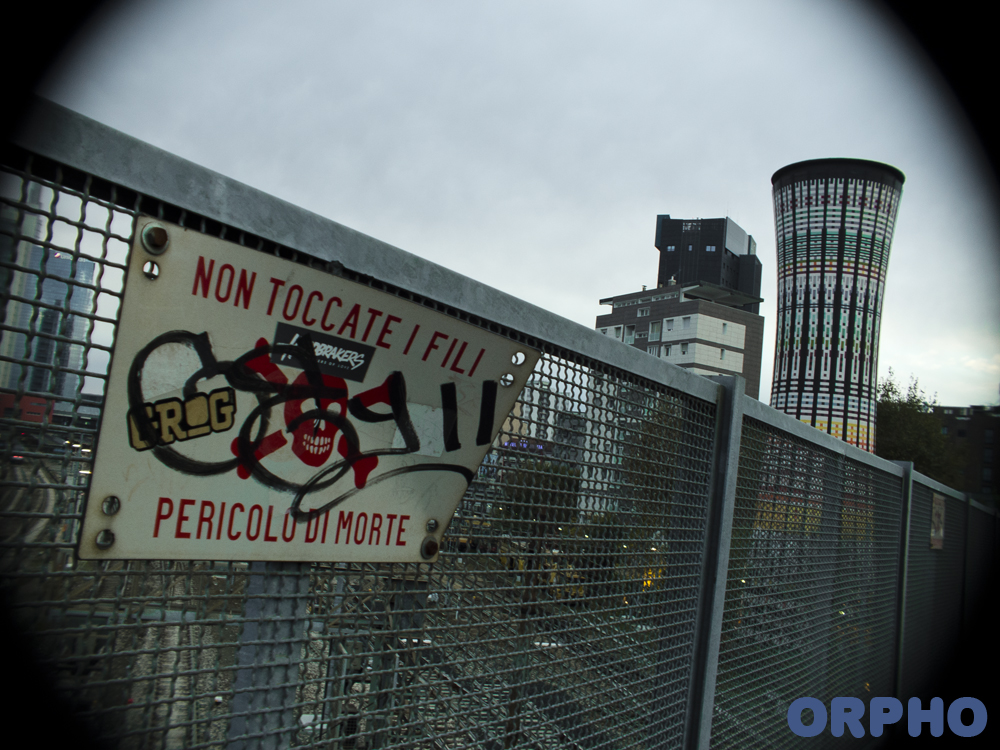
I shot this picture in the evening after the sunset, when the sky is still bright. It's possible to see the lights on the platforms, but evidently it's already too dark for the Impossible film. Despite its 640 Iso the camera required the help of the incorporated flash light to take this urban panorama. I don't like flash lights and I don't like a camera that pratically always requires the use of the flash light.
Polaroid cameras are very simple, but when something is too simple or too automated it's difficult to obtain a good result.
It's impossible to obtain photos completely clean.
If you don't count them it's impossible to know how many photos have left inside the camera because there has not a counter for this funtion.
The format of the photographs is too small and too square for my taste.
Impossible film quality is poor and not constant. Buying a film pack is always a surprise, also because the film shoud be kept in the fridge before the use and it's impossible to know how the seller retained the film.
The price of the film pack is excessive, the activity of playing should be cheaper for children and adults.


The Polaroid 600 closed in its plastic shell is protected quite well from dust and shocks.

Conclusions: not every vintage photo camera is good just because it is old and shoots on film. Impossible film has this name because it's absurd to think to get good results from it.

sabato 24 dicembre 2016

August Muth and the pure form of the analogical holography

"Holography is the demonstration that when a technique is performed in a perfect manner, the result that is obtained is artistic." TG

August Muth

Last april at the MIA of Milan I met August Muth the best holographer in the world. Holography is a real 3D kind of photography more practiced in the '80s that in the years later. This technique desappeared because holography films were discontinued. This is the interview I recorded with  Mr. August Muth that explains how he has been able to bypass this problem.

Tony Graffio: Is this the indipendent stand of an indipendent artist, isn't it?

August Muth: Yes, we are very indipendent (he laughs).

TG: So, at first I would like to understand why holography is here in a photography art exhibition?

AM: Well, as we utilize a photo sensitive emulsion formula that was developed in the early 1840's; before the current emulsions had been not even discovered. It goes back for a very long time, it was one of the very first sensitive liquid emulsion and has a different type of light recording than a phtograph.

TG: Does people know holography?

AM: In general no, it's something very new to them, but in terms of the world knowing holography there are many things in nature that they are basically holograms. Like the colours in bird feathers or in butterflies wings; they all use similar structures how holograms break light up to the colours.

TG: Holography was quite popular in the '80s, also myself I learnt how to make an hologram with a laser and simple instruments. What has changed in these last 30 years?

AM: Technologically the latest development in holography had to do with digital holography, where they take digital files and convert them in holograms. I'm not very interested in it because I really believe in a pure form where you utilising just the laser light itself to make the hologram. And they are extremely high resolution, much higher then any resolution of any other media that exist on the planet at this time. Something like 10 billions pixels per inch. When we make a hologram it records the molecular structure of the material that the hologram subject is made of.

TG: Does exist also a way to make video holography?

AM: Yes, there is something that people are calling holograms in video, but what they are is different. There are video displays systems. I see these more and more now on the web, people talking how they are making digital holograms, but in truth they are not making holograms at all. They are just paper ghosts.

TG: Would you like to talk a little bit about your education and your career please?

AM: I grow up in New Mexico wich is very much about light. Many artist from over the world travel to New Mexico because of the light. In the early age I was very interested in working with light and working in the realm of the photon. As I discovered holography I made a self training with this discipline beacause there is no educational system out there to train with holography. There are just a few people who do it. You have to learn from those people and then you go off and really self-train and discover how to improve the matter. And that's a lot of what I've done. I have developed a method where I'm making larger holograms with this emulsion in anyboby in the world. Soon I will do holograms much larger, so I 'm going to rebuild my studio to make 1,5 meter X 1,3 meter. When I will return to New Mexico that's what I do.

TG: Is anybody collaboratig with you?

AM: Yes, Dora Tass came in my studio and we worked together to produce the typewriter series. She had the contacts in Italy, so we have been invited here to the show in this fair. I've never been to Italy before, so I decided to come here with my works.

TG: You don't work with films anymore?

AM: No, holographic films don't exist anymore, we work only with gelatine emulsions, a very old process, and we coated in this way the glass plates. It's very much like in the very first photographs. We make the hologram on the gelatine and then we laminated another piece on glass on top to the gelatine to protect it from the enviroment. Essentially from scratches and things like that. 

TG: What's the difference in working with film and with gelatine emulsion?

AM: The emulsion I use doesn't really has grain at all. The structure is very fine so you can obtain a extremely high resolution, but very few people work with this emulsion because you have to coat it quicky because it only has two weeks lifetime after you make the emulsion on the glass. Then it's dead and it's not good anymore.

TG: Do you prepare the emulsion by yourself?

AM: Yes, and I make my own formula; it's like I make my own paint, because the formula as to do with what colours you research. Results depends by different formulas I mix and how old emulsion is. If it is fresh you get ones and if it has aged you obtain a different palette. So, it's very alchemical and I don't follow the same palette all the times. I'm very loose with my technology. Producing holograms is an experience more then obtaining the exact results I want.

TG: Does this involve a lot of experimentation?

AM A lot of experimentation, yes. To see what would works and what it wouldn't work.

TG: Are you able to obtain the holograms immediately or you need to try more times before to have a good result?

AM: Sometimes it takes many, many tries to get the result because the emulsion I use is very unsensitive to light so the exposure time is seven minutes. If anything move more than 1/10'000'000'000 of a meter in 7 minutes you don't get the hologram because the laser light ought has a phase with itself, so there is nothing in there. Everything has to be very still for a long time, but occasionally things move and you have something that is not there at all. Sometime I move a piece a little bit and sometime they are totally still, so they are very clear and bright. It's all part of the creative process of what I do. Everything is very experiential.

TG: Is your art appreciated in USA?

AM: It's well received, yes. I have many galleries there where I sell working, but at the same time it's something very new. People are not really used to this type of work and I'm really knowing that there is not much of this work in the United States, so there is nothing for people to compare it to. So, this is always a problem that I had. I'm very unique and individual in terms of this work, but at this point I've been doing it for 30 years and this is all I do. I don't do anything else.

TG: Does people understand the difficulties of your technique?

AM: No, not at degree at all.

TG: It's crazy!

AM: I've made many many things in my life: sculptur, photographer, for a while, when I was in college in my early days. This is by far the most difficult thing I've made in my life. In some parts of it, you must be very precise, very controlled and very scientific. In other parts of it I have to let it go and let nature be my partner in the creation of the holograms.

TG: Have you anything to do with the Multiplex?

AM: No. Those are not real holograms because they are the rays of two dimensionals film source, so it's not really a three dimensional source. I really like making true holograms, in the sense to have a real light information storage device, if you want to be scientific about it. They are real. Most people come to see my work and they say: "Ah this is a great illusion!".  No. They are real. What we see is the illusion, we see the light in a eye transfer to electro to chemical impulse, back to electro impulse to the brain. In our perceptions this is reality, or what we think reality is. Hologram is reality, just it has no mass. Because it doesn't need any mass.

TG: How much do you sell your works?

AM: In the USA usually, in my galleries, my pieces go for $ 18'000 to $ 22'000.

TG: How much time do you need to make a piece?

AM: Between 40 and 80 hours from start to finish a piece. There are many many steps, from coat the emulsion on the glass to make the exposure of the hologram. Then I have to process, to laminated and to finish the glass and creating a framing system for. There are many processes in what I do. 

TG: Do you make these processes uninterruptedly?

AM: Oh yes, it takes days doing these things, because when I coat the emulsion I have only one week of time or two days in summertime when the days are warm and humid. In wintertime when the weather is cold and dry I have to wait 4-5 days before the plates dry up. Sometimes, just the heat from my hands would go into the glass and bend the glass and so you have to wait from overheat until the glass relax again, so the glass is not bending during the exposure time. So basically everything is nearly seattled. I load a plate one day and next night I make the hologram. I load a plate next day and the nex night I make the hologram.

TG: Are you the only one to work in this way?

AM: Yes, I would say yes. There may be a few people hobbyist who do it, but I am the only one who is doing this at professional levels. And Dora. Dora comes to my studio and collaborates. I consider her as my partner. I have facilities like no other in the world, so the only way other people could produce is collaborating with me. Some people collaborating with me to produce my works and I'm able to collaborate to produce their. It's a very fluid collaboration we have (I heard from other source, a gallerist, that also James Turrell holograms are produced by August Muth).

TG: Every piece is one of the kind?

AM: Yes. I don't use masters. I want each piece is individual light recording. It's the recording of half the light interacted with the subject one year ago or six months ago. As if you look at the stars  you look at the light emitted by the stars millions years ago, but you look at the present. When you look at a hologram you look how the light reacted with the subject matter one year ago, also in the present. There is an analogy with the stars and what I do. There is a communality also in photography and what I do because I'm parcially using really old photographic techniques. Platinum photography is much more sensitive than dichromate gelatine, what I do is dichromate, and it is 4 or 5 times less sensitive than silver halides emulsions.


All rights reserved

August Muth was born in 1955 in Albuquerque, New Mexico, now his studio is based in Santa Fe. New Mexico, USA.


domenica 13 novembre 2016

Old lens big emotions: Kern-Paillard Switar 1:1,8 f 5,5mm D mount

Stazione Garibaldi Milano. Pentax Q + Switar 5,5mm f 1,8 400 Iso 1/80 sec. f 5,6

My experience with the 8mm go back at the sixties, when I was a very little child and my uncle gave me his Eumig for shooting a scene at the seaside. We were fully in the Kodacolor years. 
Last time I projected the footage I shot, around 10 years ago, I still was very surprised of my early ability in filming and of the brilliance of the colours.
Recently, we are re-discovering many things about our past and of the old tecnologies we used to film, to photograph or to listen to the music and we understand how much love the producers put in building films, lens and all the mechanical gear we used.
Nearly everything was hand made or required hand mounting, hand finishing and human competence.
Now, we are living in the plastic age, the robots are the new workers and when something breaks, it's not possible to repair it.
Thanks to a very cheap chinese D mount adapter I could give a new life, on a digital photo camera, at a precious wide angle lens unused for too much time.

My Pentax Q with a Switar  5,5 mm f 1,8  (serial number 827243) and the D mount P/Q adapter

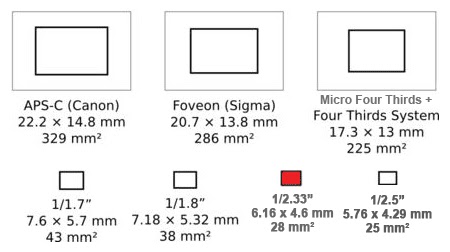
The Pentax Q has a sensor of mm 6,16 X, 4,6
The 8 mm cine standard frame is mm 4,5 X 3,3

Digital sensor comparison. The Pentax Q has a sensor of 1/2,3″ inch.

8mm cine formats comparison

This means that there is a little difference between the two formats, also if the 8mm was born around 80 years before the digital Pentax Q. And it could be possible to cover the new format with the old lens, also if it is possible having some problems with the wide angles.
I estimate that a focal lenght of 5,5mm on a Pentax Q format should correspond at a 28mm on a 24X36 mm frame.
Usually, this is not an extreme wide angle lens, but on a very little format it's quite difficult to make o to find a wider lens. The Kern-Switar 5,5mm f 1,8 was one of the best wide angle for filming in 8mm.
It's also true that using an old lens to shoot on digital it's always a difficult compromise because films and electronic sensors  work in a very different manner.

Before the Sunrise. Milan, via Farini. November 13th 2016. Pentax Q + Switar 5,5mm f 18 Iso 125; 1/25 sec. f 4.

Same shot in a different version (B/N)

The lens
The lens is gorgeous, is made with aluminium and brass and has the optical coating. The iris is continuos and has 8 blades. The minimum focus distance is very short: cm 11, so we nearly could call this Kern: Macro Switar. The focusing ring, as the iris ring is very smooth and precise. In this way if we need to open the iris, make the focus and close again the iris, it's possible to make this operation without to change the focusing distance by mistake. But we still need to make attention because the dimensions of the 5,5mm are quite small. Made in Switzerland at the end of the 50's.

Collimation
I've been able to use the Switar 5,5mm on my camera without change the distance at the infinity focus, but the distance reported on the ring didn't correspond at a real value, so I could focus only watching the display of my Pentax Q.
The lens came from a Bolex Paillard DL8. I tested other lens coming from other cameras, as some Claston and others Kern coming from a Bolex Paillard B8. I found that the lens coming from the B8 were the only lens usable on my Pentax Q without perform a new collimation.
Optical collimation is a corretion made with some thin rings to put on the back of the attacmente of the lens so that infinity focus coincides exactly on the focal plan, where the sensor or the film is. 

Vignetting & Co.
Because the Pentax Q format is larger than the standard 8mm there is a strong vignetting on the corners of the images. Distorsion is weak, but visible. Chromatic distortion is also visible because the colours focus on different plans on film and on CMOS.

Final Judgement
Working with a full manual lens on a automatic focus digital camera is never funny, you lose time and you need to make additional clicks to be sure to be on focus: also because it's possible to move the focus ring by mistake when you close down the iris after you focused the subject at the iris wide open. Kern-Paillard are the best optics you can find, not only for 8mm, but also for other formats, like 35mm, but using them on a digital camera could be done only to find vintage atmospheres, having an alternative to change lens, for fun, for trying something new, or because these lens are very, very fast. They are not so suggested for a use in colour photography: I think it has more sense use them for black and white photography or for videomaking. Best again for filmaking, also beacause you can still order your 8mm (double 8mm, if you prefere), Super8 or 16mm at http://www.wittnerkinotechnik.de/katalog/04_filmm/d8_filmm.php TG


lunedì 31 ottobre 2016

Tony Graffio and the "The Lightcatcher"

Tony Graffio is a technical sponsor of "The Lightcatcher"

For almost two years, I document and diffuse indipendently the works of the artists of our time through the pages of graffitiamilano.blogspot.it
In view of the opening of my blog ortodossiafotografica, I was moved to find photographers whose story deserves to be told and maybe support them technically and economically in their projects.
During summer 2014 I met "The Lightcatcher," I listened to his ideas, and let myself be charmed by his beautiful and courageous project; I understood the difficulties that presented some aspects of his business, so I decided to do something to help him.
From the time, I was also fascinated by the idea of contributing to preserve ancient knowledge of almost lost techniques and  to promote those involved in these projects.
In this way Ortodossia Fotografica and Frammenti di Cultura have born as cultural initiatives with the aim to create objects of technical use which are difficult to find on the market of the new millennium, or totally out of production, elements that can be built only with traditional methods.

I will cover this talk in more detail some other time, for now I wanted to let everyone who follow me to know that in these pages I will evaluate other artists and other ideas to which I could participate with technical sponsorships or in other forms, within the limits of my possibilities.

The Lightcatcher inside his Ural 6X6
Inside a very special vehicle (July 2014)


If you are interested to let me know your projects, you can contact me, as always, to my personal cell phone: 3339955876 or by email to ortodossiafotografica@gmail.com Tony Graffio

The Lightcatcher is sponsored by Tony Graffio


If you wish to help Kurt to realize his dream you can send 

an International Bank Transfer to the bank account on the 

bottom.


IBAN: IT89J0818758740000001021695

BIC: RZSB IT 21030


sabato 1 ottobre 2016

The Bolaskop Benatti Polaroid Prototype n.4

few weeks ago, a friend of mine, knowing my passion for photography, called me telling to have something very interesting to show me.
Alex Gordon is an extravagant person, but he is very honest and sincere, so I really expected to see something very strange and rare... Alex like me lives in Milan and he is a camera operator. He is always very busy, so a morning we met in an ice-cream shop in Bovisa, close to Emma Canepari's Speed Photo Shop and I saw for the first time in my life a Bolaskop.

Alex Gordon
 Alex Gordon and his Bolaskop mounted on a Nikon F3

Bolaskop Polaroid
 The Bolaskop was a prototype able to print big pictures direcly on Polaroid paper through a few prisms. It was made by Benatti, the lens mount wizard of Milano.

Prototype n. 4
 This is the Bolaskop number 4. I doubt there could be more than 5 of these jewels around the world... If you are able to find one, please let me know it.

Alex Gordon's Bolaskop
The Bolaskop mounted on a Nikon F3. I think it was made at least 30 years ago, but it's still like new.
 Sorry for the photographs, they where all made with a mobile phone...


domenica 26 giugno 2016

One take, one frame, one camera: Leica CL Hybrid Wide Tony Graffio

Is the Leica CL a real Leica? This is not a problem for me. I like Leica cameras, but I'm not a maniac of this brand, they are just a little bit too expensive for me, expecially in these days many people is looking for Leitz lens to mount them on the new digital Leicas. Years ago, I owned a very nice Leica M4 with a Summicron f 2, the results were stunning, but I was used to my Nikon F2 so, after a while, I sold the M4 thinking to break-up definitively my relationship with the german red dot. 
Not so much time ago, I would say 2 years, I bought an old Leicaflex SL, later another, and then an older Leicaflex, because the R series was not so wanted. Just in time, because since a few months also the Leicaflex and the R series lens began to be more appreciated and expensive...
Last march I went to the Castel San Giovanni second hand photographic market and when I found a Leica CL at 130 euros I decided to buy it also if the lightmeter was not working and there was not any lens on the camera body. 
Good move. The lightmeter problem was not so serious, the CL just needed to sobstitute an oxidized cable and very quickly became ready to take some pictures again. 
Then, the problem was: where to find a lens at a reasonable price? 
I was not in the mood to spend around 2'000 euros for a 21mm or any other original focal lenght so I understood I had not to watch on a Leitz product. I started to think at a few alternative options. I compared the Cosina/Voigtlander to the Zeiss and other lens with an M mount and I realized that Nikon wide angles could be not worse than those makes, and not even slower.
I started to look after lens adapter and I decided to find something that could allow me to mount a Nikon on my Leica/Minolta CL.

This Hybrid Camera is a Leica/Minolta rangefinder camera Leica M Mount with a Nikkor AIS mm 20 f 2,8, a Cambo Wide 650 Viewfinder and a no brand lens hood


I know it is a unusual choice, everybody would like to take advantage of the Leitz optical quality, but I wanted to put together a small light camera with what I already had. I had only to look for the right adapter, I already owned all the rest of the gear. Of course, I could mount every kind of Nikon lens on my solution, but not having the possibilty to focus precisely meant to be forced to mount a very wide lens on the CL. The good new is that the compact Leica/Minolta has an internal cell that enables the TTL metering system to work also with a lens adapter and a manual diaphragm lens, like the Nikon AIS.

 The Bovisa old gasometer photographed with my Hybrid solution. Fujifilm Fujicolor 200 E.I. 1/500 sec. f 11


The entrance in the AEM area where rise the old gasometers is forbidden to the public. So, I guess, I introduced myself illegally in this place to document what happened, what kind of works were made and what is the actual situation. 
I needed to have my hands free to cut the wild vegetation and to have a small and light camera with me, in the case I had to runaway quickly.
Camera was already mounted with the adapter and the 20mm in a small bag. In another pocket of the bag I kept the lens hood and the Cambo viewfinder. To take the pictures I had to take off the lens cap, mount the lens hood, mount the  cambo wide angle viewfinder, focus at a quite closed aperture, expose the scene with the internal meter, compose the image and shoot the picture.

Leicaist Nik-L/M lens adapter


I don't like anymore buiyng online on the web, so I searched a shop in Milan where to find any make of lens adapter.
Nobody had it, so I went by my trusted chinese bazaar to explain what I needed.

 Federica, more than a chinese seller, a property master


Federica already had been able to find for me an adapter in China for a Pentax Q to any D mount (8 mm cine cameras) lens, so I asked again to her to solve my problem. I've been lucky because she already had to make a journey to Shanghai and she looked for it directly in her hometown. 
A couple of weeks later she came back with my adapter, 100% Made in China. 
Thanks Federica and thanks to the industrious wise chinese people that build in their old and big country what we lazy italian people don't want to make anymore. I payed the Leicaist adapter 43 euros.

Tony Graffio's Leica CL Wide Hybrid, a Nippo-German-Dutch- Chinese camera.